Harbin Medical University (HMU) MBBS in China | Fee Structure, Scholarships & Eligibility Guide 2026
About the University
Founded
1926
Ranking
Project 211 · #106 China
Top-100 Hospitals
3 of 5
English MBBS Since
1997
Harbin Medical University (HMU) was founded in 1926 by Dr. Wu Liande, a Malaysian-born Chinese physician who graduated from Cambridge in 1903. Dr. Wu had earlier organized China's response to the 1910–1911 Manchurian pneumonic plague - the first time a major epidemic was controlled using modern quarantine and protective equipment, a landmark moment in global public health history. He was nominated for the Nobel Prize in Physiology or Medicine in 1935. This founding legacy gives Harbin Medical University an institutional identity rooted in scientific rigor and public health commitment that distinguishes it from purely clinical-focused institutions.
Harbin Medical University is a Project 211 key university, the only higher medical school in Heilongjiang Province authorized to enroll international students in the English MBBS program, and one of the first 30 universities approved by China's Ministry of Education in 1997 to offer English-medium MBBS to international students - giving it nearly three decades of international program track record. The university ranks #106 in China according to CWUR 2026 and holds 1 national key discipline, 32 provincial key disciplines, and hosts the National Research Center for Clinical Trial of New Drugs. Three of its five directly affiliated hospitals are ranked among China's national top 100.
Harbin Medical University operates two campuses: a 2.36 million sq m main campus in Harbin with architecturally distinctive ancient Chinese-style buildings, and a Daqing satellite campus. Total faculty stands at 18,312. The university has 16,507 undergraduate and 8,915 postgraduate students, including 1,605 doctoral candidates. It cooperates with Nankai University and Harbin Institute of Technology for joint teaching and maintains partnerships with 5 foreign universities for joint medical programs. International students from 20+ countries are enrolled, drawn by the combination of competitive fees, Project 211 research infrastructure, and top-100 hospital clinical training.

Harbin Medical University Main Campus - Ancient Chinese-Style Architecture, Harbin
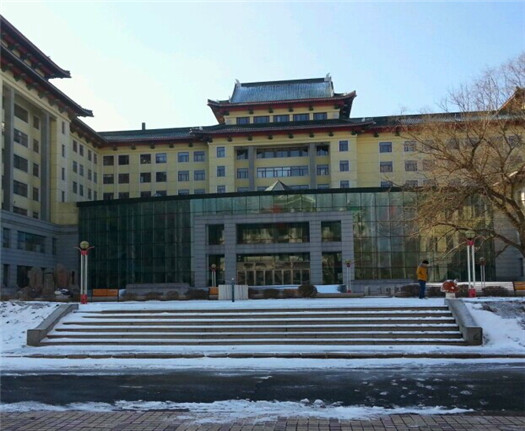
Harbin Medical University Campus in Winter - Central Heating Throughout, Harbin
📷 Photos: Wikimedia Commons (CC BY-SA)
Medical Program and Faculty
Duration
6 Years
Medium
Full English
Clinical Training
5 Hospitals
The MBBS (Clinical Medicine) program at Harbin Medical University (HMU) is fully English-medium and has been running continuously since 1997 - making it one of the longest-running international MBBS programs in China with nearly three decades of track record. The syllabus is specifically structured to align with South Asian medical licensing requirements: NMC India (FMGE/NExT), PMC/PMDC Pakistan (NRE/NLE), and BMDC Bangladesh. A key practical advantage is Harbin Medical University's dedicated exam preparation coaching for FMGE, USMLE, PLAB, AMC, and equivalent licensing examinations - a formal support program not offered at all Chinese MBBS universities.
The 6-year curriculum follows a structured progression: Year 1 combines Chinese language study with basic sciences foundation; Years 1–2 cover basic medical sciences including Anatomy, Physiology, Biochemistry, Microbiology, Pharmacology, Pathology, Histology and Embryology, and Medical Immunology; Years 3–5 cover clinical medicine including Internal Medicine, Surgery, Gynaecology and Obstetrics, Paediatrics, ENT, Ophthalmology, Dermatology, Anaesthesia, Orthopaedics, and Emergency Medicine; Year 6 is the compulsory clinical internship. A specific academic distinction at Harbin Medical University is its joint teaching collaboration with Nankai University and Harbin Institute of Technology for the 7-year medical program track, and cooperation with 5 foreign universities for joint medical programs.
The faculty totals 18,312 across both campuses. Harbin Medical University holds 1 national key discipline, 32 provincial key disciplines, and hosts the National Research Center for Clinical Trial of New Drugs - a facility typically found only at top research institutions. The university has undertaken 250+ national projects including Project 973, Project 863, and NSFC key research programs, and has received 3 second-class National Scientific and Technological Progress Awards and 3 second-class National Natural Science Awards since 2000. HSK-4 is required before graduation and degree conferral only - no HSK is required at any point during the 6-year program itself.
Faculty strength: 18,312 total faculty · 1 national key discipline · 32 provincial key disciplines · National Research Center for Clinical Trial of New Drugs on campus.
Affiliated Hospitals and Clinical Training
5 Affiliated Teaching Hospitals · 3 of 5 Ranked in China's National Top 100
Comprehensive clinical exposure across all major disciplines throughout the 6-year program.
First Affiliated Hospital of Harbin Medical University
China's Top 100 Hospital · Major comprehensive teaching hospital · Primary base for Year 6 internship rotations
Second Affiliated Hospital of Harbin Medical University
China's Top 100 Hospital · Strong in cardiology, neurology, and internal medicine
Third Affiliated Hospital of Harbin Medical University
China's Top 100 Hospital · Specialist clinical training across multiple departments
Fourth Affiliated Hospital of Harbin Medical University (Harbin First Hospital)
General clinical teaching hospital
Daqing Campus Affiliated Hospital
Teaching hospital serving Daqing campus students

First Affiliated Hospital of Harbin Medical University - Qunli Campus (China Top 100)

Fourth Affiliated Hospital of Harbin Medical University - Clinical Teaching Facility
📷 Photos: Wikimedia Commons (CC BY-SA)
Harbin City and Campus Environment
Province Capital
Heilongjiang
Winter
−13°C to −30°C
Summer
18–28°C
Airport
Taiping International
Harbin is the capital of Heilongjiang Province in China's far northeast, bordering Russia. Known internationally as the 'Ice City' and 'Eastern Paris,' Harbin carries a distinctive Russian-influenced architectural heritage from the early 20th century when it served as a major Russian railway town. The city is world-famous for its annual International Ice and Snow Sculpture Festival held every January - one of the largest winter festivals on the planet, drawing millions of visitors and featuring enormous illuminated ice sculptures along the Songhua River. Harbin Taiping International Airport connects to Beijing, Shanghai, and other major Chinese hubs, with Pakistan connections typically routing through Beijing or Shanghai.
Harbin has genuinely extreme winters - the most significant practical consideration for South Asian students choosing Harbin Medical University. Temperatures average −13°C to −30°C from November through March. All campus buildings and hostels have full central heating throughout winter. Students must arrive prepared: thermal base layers, a heavy insulated coat, gloves, and waterproof boots are essential. Most South Asian students adapt within their first season. Summers are warm and pleasant at 18–28°C, and the transition between Harbin's dramatic seasons creates a memorable and unique student experience.
Cost of living in Harbin is lower than most other Chinese university cities. Food costs approximately 800–1,000 RMB per month. The Harbin Medical University main campus is architecturally distinctive with ancient Chinese-style buildings set along tree-lined paths, famous among alumni for the lilac fragrance that fills the campus each spring. The surrounding academic neighborhood includes bookstores, markets, and restaurants. Sports facilities are comprehensive: indoor stadium, swimming pool, gymnasium, football, basketball, and tennis courts. 30+ student cultural and sports clubs are active, and the library holds 500,000+ volumes alongside extensive digital resources.
Student life: Cost of living in Harbin is lower than most Chinese cities. Campus hostels are centrally heated with separate male and female blocks. Food costs approximately 800–1,000 RMB/month. 30+ student clubs active on campus.
International Recognitions and Approvals
Important Admission Requirements
IELTS / TOEFL Requirement
IELTS 6.0+ or TOEFL 70+ is mandatory for Harbin Medical University MBBS admission. Applicants from English-medium secondary schools may be eligible for an exemption - confirm with Titans Abroad whether your institution qualifies. Applicants without IELTS/TOEFL who do not qualify for exemption can take Harbin Medical University's own English placement test. Plan IELTS preparation at least 3–6 months before the September intake deadline (approximately 31 August).
Online Interview
An online interview conducted by Harbin Medical University faculty is mandatory and its outcome affects the admission decision - it is not purely a formality. The interview assesses English communication ability, academic motivation, and awareness of the medical field. Titans Abroad provides preparation guidance before your Harbin Medical University interview.
Age Limit
Harbin Medical University enforces a strict age limit that is tighter than most Chinese MOE-listed universities. Male applicants must be 18 to 21 years old at time of enrollment. Female applicants must be 18 to 22 years old. Applications from candidates outside these age ranges will not be processed regardless of academic qualifications. Check your age carefully before beginning the Harbin Medical University application process.
Program Details
| Field | Details |
|---|---|
| Program | Clinical Medicine (MBBS) | Full English Medium |
| Duration | 6 Years (5 academic + 1 internship) |
| Intakes | September (Annual) - deadline approximately 31 August |
| Medium | Full English Medium (MOE Listed) |
| University Type | MOE Listed | Project 211 | Public | Heilongjiang Province Key University |
| Location | Harbin, Heilongjiang Province (+ Daqing Campus) |
| Annual Tuition | 30,000 RMB/year |
| Annual Hostel | 5,400 RMB/year (double room) |
| IELTS / TOEFL | IELTS 6.0+ or TOEFL 70+ (mandatory) |
| Online Interview | Required - performance affects admission outcome |
| Age Limit | Boys: 18–21 | Girls: 18–22 (strictly enforced) |
| HSK Requirement | HSK-4 before graduation only; no HSK during program |
| English MBBS Since | 1997 - one of first 30 MOE-approved universities |
| CSCA Exam | Required (specific subjects TBC - confirm with Titans Abroad) |
| Founded | 1926 by Dr. Wu Liande (Cambridge; Nobel-nominated plague pioneer) |
Campus & Facilities
Harbin Main Campus
📍 Harbin, Heilongjiang Province
2.36 million sq m campus featuring ancient Chinese-style buildings set against tree-lined paths, famous for its spring lilac fragrance. Facilities include a library with 500,000+ volumes, 50+ modern science laboratories, an indoor stadium, swimming pool, gymnasium, football, basketball, and tennis courts, and 30+ student clubs. Centrally heated hostels with double rooms, AC and non-AC options, separate male and female blocks, and CCTV security throughout.
Daqing Campus
📍 Daqing, Heilongjiang Province
Satellite campus with 520 faculty and a dedicated affiliated teaching hospital. MBBS international students are primarily based at the Harbin main campus.
MOE Listed: What This Means?
Eligibility Criteria
Required Documents
Fee Structure
Application fee (1,500 RMB) paid separately. Year 1 includes tuition, hostel, visa extension, insurance, medical checkup, and one-time liaison & management charges. From Year 2 onwards: tuition 30,000 + hostel 5,400 + visa & insurance 1,600 = 37,000 RMB/year. Electricity is billed separately based on usage.
Visa Extension (800) + Insurance (800) + Medical Checkup (400) + Liaison & Management Charges (15,000)
Visa (800) + Insurance (800)
Visa (800) + Insurance (800)
Visa (800) + Insurance (800)
Visa (800) + Insurance (800)
Visa (800) + Insurance (800)
| Year | Tuition | Hostel | Other Fees | Total (RMB) |
|---|---|---|---|---|
| Year 1 | 30,000 RMB | 5,400 RMB | Visa Extension (800) + Insurance (800) + Medical Checkup (400) + Liaison & Management Charges (15,000) | 52,400 RMB |
| Year 2 | 30,000 RMB | 5,400 RMB | Visa (800) + Insurance (800) | 37,000 RMB |
| Year 3 | 30,000 RMB | 5,400 RMB | Visa (800) + Insurance (800) | 37,000 RMB |
| Year 4 | 30,000 RMB | 5,400 RMB | Visa (800) + Insurance (800) | 37,000 RMB |
| Year 5 | 30,000 RMB | 5,400 RMB | Visa (800) + Insurance (800) | 37,000 RMB |
| Year 6 (Internship) | 30,000 RMB | 5,400 RMB | Visa (800) + Insurance (800) | 37,000 RMB |
| Total (6-Year MBBS Program) | ~237,400 RMB | |||
Notes on the fee structure:
- •Total 6-year cost: approximately 237,400 RMB (double room hostel).
- •Electricity charges are not included in the hostel fee - billed separately based on usage.
- •Application fee (1,500 RMB) is paid separately and is not included in the above totals.
- •All fees are non-refundable once paid. Fees quoted in RMB and subject to change - confirm current rates before applying.
- •Liaison, processing and management charges (RMB 15,000) are one-time only in Year 1. These include: Documents attestation guidance, Gerry visa processing assistance, Visa interview preparation, Pre-departure services, Luggage and Travel advice, Group travelling arrangements, Post landing services, contractor charges, university selection guidance, Office Service Fee, JW202/Visa Letter, Courier, Pickup etc.
Scholarships
Coverage
Partial tuition reduction - awarded for academic excellence
Eligibility
Outstanding international students at Harbin Medical University - based on academic performance
Coverage
Partial to full coverage - competitive
Eligibility
Outstanding international students at Heilongjiang Province universities
Coverage
Full tuition + hostel + RMB 2,500/month stipend + insurance
Eligibility
Competitive selection; apply via CSC portal (December–April); all nationalities eligible
Coverage
Partial - for students demonstrating Chinese language learning alongside their degree
Eligibility
Students with Chinese language interest and demonstrable ability
| Scholarship | Type | Coverage | Who Can Apply |
|---|---|---|---|
| Harbin Medical University President Scholarship | University Merit | Partial tuition reduction - awarded for academic excellence | Outstanding international students at Harbin Medical University - based on academic performance |
| Heilongjiang Provincial Government Scholarship | Provincial Government | Partial to full coverage - competitive | Outstanding international students at Heilongjiang Province universities |
| Chinese Government Scholarship (CSC) | Full Government Scholarship | Full tuition + hostel + RMB 2,500/month stipend + insurance | Competitive selection; apply via CSC portal (December–April); all nationalities eligible |
| Confucius Institute Scholarship (CIS) | Government Scholarship | Partial - for students demonstrating Chinese language learning alongside their degree | Students with Chinese language interest and demonstrable ability |
Titans Abroad provides free guidance on CSC scholarship applications, study plan writing, and document preparation. WhatsApp us to get started.
By the Numbers
18,312
Total Faculty
16,507
Undergraduate Students
8,915
Postgraduate Students
172–377
Intl. Students
20+
Countries Represented
Why Harbin Medical University Is Worth Considering?
- 1Founded by Dr. Wu Liande (Cambridge-educated, Nobel-nominated, plague-fighting pioneer): the most historically distinctive founding story of any university in this guide, embedded in Harbin Medical University's research identity.
- 23 of 5 directly affiliated hospitals in China's national top 100: exceptional clinical training quality and patient volume that few other MOE-listed MBBS universities can match.
- 3One of first 30 MOE-approved English MBBS universities (1997): nearly three decades of international student track record with documented NMC, PMDC, and BMDC licensing outcomes.
- 4Project 211 university: national key research designation with 1 national key discipline, 32 provincial key disciplines, and the National Research Center for Clinical Trial of New Drugs on campus.
- 5CWUR #106 in China and ranked top 15 for English-taught MBBS programs nationally.
- 6Dedicated exam prep coaching for FMGE, USMLE, PLAB, AMC - a formal South Asian licensing preparation program aligned specifically with NMC, PMC/PMDC, and BMDC curricula.
- 737,000 RMB all-in annual (tuition + hostel + visa + insurance from Year 2): one of the most competitively priced Project 211 universities in this guide, with a hospital network that rivals far more expensive options.
- 8Year 6 internship can be completed in Harbin Medical University's affiliated hospitals or in the student's home country - subject to PMDC/NMC approval and Harbin Medical University agreement.
- 9MOE Listed and simultaneously recognized by PMC/PMDC Pakistan, NMC India, BMDC Bangladesh, WHO, ECFMG, WFME, and WDOMS.
- 10Harbin: the 'Ice City' - world-famous International Ice and Snow Festival, unique Russian-influenced architecture, and a genuinely distinctive student experience unavailable at any other university in this guide.
How to Apply via Titans Abroad
If you want to apply for Harbin Medical University (HMU), the most important first steps are verifying your age eligibility, obtaining IELTS 6.0+, and confirming the CSCA subject combination with Titans Abroad. Harbin Medical University's age limit is strictly enforced and IELTS is mandatory - start these preparations well in advance. Titans Abroad guides you through IELTS planning, CSCA registration, document preparation, online interview preparation, cold-weather planning, and full support until departure and post-landing in Harbin.
Application Process
Send Your Documents
Email apply@titansabroad.org or WhatsApp us with your passport, transcripts, and photo.
Free Consultation
We contact you within 24 hours to confirm eligibility, review documents, and recommend the right university.
Application Fee
Varies by university - our team confirms the exact amount before you pay. This starts the formal admission process.
Pre-Admission Letter
The university issues your pre-admission letter within 7–10 working days of complete documents and application fee.
Visa Processing
We guide you through the JW202 letter and all Chinese embassy documents. Typically 20–30 working days.
Arrive in China
Once your visa is stamped we coordinate your arrival date with the university. Airport pickup assistance available.
Processing time: Pre-admission letter within 7–10 working days. JW202 visa letter within 20–30 working days. Total process from application to visa: approximately 40–60 working days. Apply early to avoid missing the September intake deadline.
We help you with
Consultation is free. No charges until you are ready to formally proceed.
Dr. Tayyab · Pakistan
+92 341 7964379
Dr. Tayyab · China Office
+86 156 7127 6517
Email · Applications & Docs
apply@titansabroad.org
Frequently Asked Questions
What is the age limit at Harbin Medical University (HMU)?
The age limit at Harbin Medical University (HMU) is stricter than most MOE-listed universities in China. Male applicants must be 18 to 21 years old at time of enrollment. Female applicants must be 18 to 22 years old. This is strictly enforced - applications outside these age ranges will not be processed regardless of academic qualifications. Check your age carefully before beginning the Harbin Medical University application process.
Is IELTS mandatory at Harbin Medical University (HMU)?
Yes. Harbin Medical University (HMU) requires IELTS 6.0+ or TOEFL 70+ for MBBS admission. Applicants from English-medium secondary schools may qualify for an exemption - confirm with Titans Abroad. Applicants without IELTS/TOEFL who do not qualify for exemption can take Harbin Medical University's own English placement test. Plan IELTS preparation at least 3–6 months before the September intake deadline.
What is the CSCA requirement at Harbin Medical University (HMU)?
Harbin Medical University (HMU) requires the CSCA (China Standardized College Entrance Exam for International Students) for MBBS admission. Harbin Medical University has not yet published the specific subject combination for MBBS. Titans Abroad will confirm the exact subject combination before you register for the exam - contact us before booking your CSCA to avoid registering for the wrong subjects.
How cold does Harbin get and how do students at Harbin Medical University (HMU) manage?
Harbin winters are genuinely extreme: average −13°C to −30°C from November through March. Harbin Medical University (HMU) campus hostels have full central heating throughout winter. Students need proper cold-weather clothing - thermal base layers, a heavy insulated coat, gloves, and waterproof boots. Most South Asian students adapt within their first winter season. The cold is offset by the unique experience of Harbin's annual International Ice and Snow Festival, one of the most spectacular winter events in the world.
Is Harbin Medical University (HMU) PMC/PMDC recognized for Pakistani students?
Yes. Harbin Medical University (HMU) is PMC/PMDC recognized, making graduates eligible for the NRE/NLE examination in Pakistan. Harbin Medical University is also NMC India approved (FMGE/NExT eligible) and BMDC Bangladesh approved. As a MOE-listed university, Harbin Medical University carries the highest tier of international recognition available for a Chinese MBBS program. Always verify the current NOC status before applying as recognition lists can be updated.
Who was Dr. Wu Liande and why is Harbin Medical University (HMU) associated with his legacy?
Dr. Wu Liande (1879–1960) was a Malaysian-born Chinese physician who graduated from Cambridge in 1903. He organized China's response to the 1910–1911 Manchurian pneumonic plague - the first time a major epidemic was controlled using modern quarantine protocols and protective equipment, a method that became the global template for epidemic control. He was nominated for the Nobel Prize in Physiology or Medicine in 1935. Dr. Wu founded Harbin Medical University (HMU) in 1926, and his legacy of scientific rigor and public health commitment continues to shape Harbin Medical University's research identity and institutional orientation.
Can students of Harbin Medical University (HMU) do their Year 6 internship in Pakistan?
Yes. Harbin Medical University (HMU) final-year students can complete their Year 6 internship either in Harbin Medical University's 5 affiliated hospitals in Harbin or in their home country, subject to PMDC requirements and Harbin Medical University approval. Titans Abroad can advise on the current policy and documentation required for a Pakistan internship placement from Harbin Medical University.
Why is Year 1 fee at Harbin Medical University (HMU) more expensive than the following years?
Year 1 at Harbin Medical University (HMU) is higher because it includes several one-time charges that never appear again. On top of the standard tuition (30,000 RMB), hostel (5,400 RMB), visa extension (800 RMB), and insurance (800 RMB), Year 1 at Harbin Medical University also covers a medical checkup (400 RMB) and a one-time liaison, processing and management fee of 15,000 RMB - bringing the Harbin Medical University Year 1 total to 52,400 RMB. From Year 2 onwards you only pay tuition, hostel, visa extension, and insurance, which totals 37,000 RMB per year. The liaison and management fee covers: documents attestation guidance, visa processing assistance, visa interview preparation, pre-departure support, luggage and travel advice, group travelling arrangements, post-landing services, JW202/visa letter, courier, airport pickup, and more.
What is the total 6-year MBBS cost at Harbin Medical University (HMU)?
The total 6-year MBBS cost at Harbin Medical University (HMU) is approximately 237,400 RMB. Year 1 is 52,400 RMB (includes the one-time liaison fee and medical checkup). Years 2 to 6 are 37,000 RMB each (tuition 30,000 + hostel 5,400 + visa 800 + insurance 800). This makes Harbin Medical University (HMU) one of the more affordable MOE-listed options in the guide despite its Project 211 status and 3 Top-100 hospitals. Application fee (1,500 RMB) is separate.
What online interview is required at Harbin Medical University (HMU) and how to prepare?
Harbin Medical University (HMU) requires an online interview as part of the admission process. The interview assesses English communication ability, motivation for studying medicine, and general academic suitability. It is typically conducted via video call after initial shortlisting. Prepare a clear, confident introduction of yourself, your reasons for choosing Harbin Medical University, and your academic background. Titans Abroad provides interview preparation guidance to help you practice common questions and present yourself effectively.
What is the HSK requirement at Harbin Medical University (HMU)?
Harbin Medical University (HMU) follows the standard MOE requirement: HSK Level 4 must be passed before graduation and degree conferral. No HSK examination is required during the MBBS program or for admission. The MBBS program at Harbin Medical University is taught entirely in English - IELTS 6.0+ (or TOEFL 70+) is the English proficiency requirement at entry, while HSK-4 is the Chinese language milestone required at the end of the 6-year program. Students should progressively build Chinese language skills through optional language courses and daily exposure in Harbin so that the HSK-4 graduation requirement is met comfortably before the final year.
Can Indian students study MBBS at Harbin Medical University? Is NEET required?
Yes — Indian students are welcome at Harbin Medical University. NEET is mandatory for all Indian students studying MBBS abroad (NMC rule since 2019). You must qualify NEET with a minimum 50th percentile (General category) or 40th percentile (reserved categories) before applying. After completing your 6-year MBBS, you must pass the FMGE/NExT examination to practice medicine in India. Harbin Medical University is MOE-listed and WHO recognized, making it eligible for NMC compliance and FMGE/NExT registration.
Can Bangladeshi students study MBBS at Harbin Medical University? Is the degree BMDC recognized?
Yes — Bangladeshi students are welcome at Harbin Medical University. The university is MOE-listed by the Chinese Ministry of Education and recognized in the World Directory of Medical Schools (WDOMS), making it BMDC-eligible. No national entrance exam (like India's NEET) is required from Bangladesh — SSC and HSC certificates with Physics, Chemistry, and Biology subjects are the core academic requirements. After completing MBBS, Bangladeshi graduates must pass the BMDC licensing examination to practice medicine in Bangladesh.